First Series 1853-1855
1853 Nesbitt Issue
An Act of Congress March 3, 1845 effective July 1, 1845 fixed the rate of postage by weight instead of for the number of pieces or sheets of paper enclosed. August 31, 1852 Congress passed an act authorizing the Postmaster General to provide "suitable letter envelopes, with such watermarks or other guards against counterfeits as he may deem expedient, and with one or more suitable postage stamps with such device and of such denominations and value as he may direct. printed or impressed thereon, which envelope shall be sold at the cost of procuring and furnishing same, as near as be, with the addition of the value or denomination of the postage stamps so printed or impressed thereon." Also the envelope had to be sealed so the contents could not be removed without destroying the envelope. Futher thje date it was recieved was to be written or stamped on the envelope to prevent reuse. The George F. Nesbitt Co, New York. NY was awarded the contract for manufacturing these envelopes October 25, 1852. The first series of stamped envelopes in 3¢ and 6¢ denominations was delivered to the Postmasters in June 1853 and the 10¢ denomination appeared April 25, 1855. The envelopes were sold at 18¢, 20¢ and 32¢ per hundred for the note, letter and officil size respectively, plus the value of the stamps. Stamped envelopes were thought useful and anticipated all over the United State. This is a typical example from the Baton Rouge, Louisiana newspaper The Daily Comet November 4, 1852.
There is no evidence that a 24¢ envelope was ever made. None are known to exist.
|
|
The Nesbitt Seal
The first delivery of five million envelopes bore the Nesbitt seal on the point of the back flap. There are several versions of the seal which can be looked at here, but todays collectors don't consider the differences important.
|
|
The Nesbitt Watermarks
|
|
The Nesbitt Knives |
|
The Collection
| U1 | U2 | U3 | U4 | U5 | U6 | U7 | U8 | U9 | U10 | U11 | U12 | U13 | U14 | U15 | U16 | U17 | U18 |
3 Cent 6 Cent
|
 The United States' First Postal Stationary
 The early Nesbitt envelopes carried Nesbitt's
seal or crest on the point of the back flap.
The early Nesbitt envelopes carried Nesbitt's
seal or crest on the point of the back flap.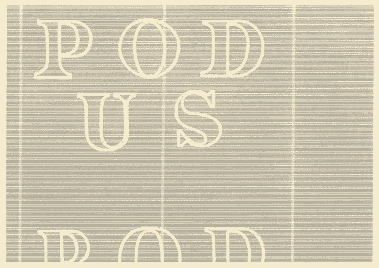 There two major paper varieties: horizontally
laid and diagonally laid. The horizontally laid paper comes in two
vaiations differentiated by the distence between the chian lines.
The diadonally laid paper has seven variations that ard determined
both by angle from the perpendicular of the laid lines and the
relative posisioning of the US POD watermark (called warermark 1
or WMK 1).
There two major paper varieties: horizontally
laid and diagonally laid. The horizontally laid paper comes in two
vaiations differentiated by the distence between the chian lines.
The diadonally laid paper has seven variations that ard determined
both by angle from the perpendicular of the laid lines and the
relative posisioning of the US POD watermark (called warermark 1
or WMK 1). The early Nesbitt envelopes carried Nesbitt's
seal or crest on the point of the back flap.
The early Nesbitt envelopes carried Nesbitt's
seal or crest on the point of the back flap.